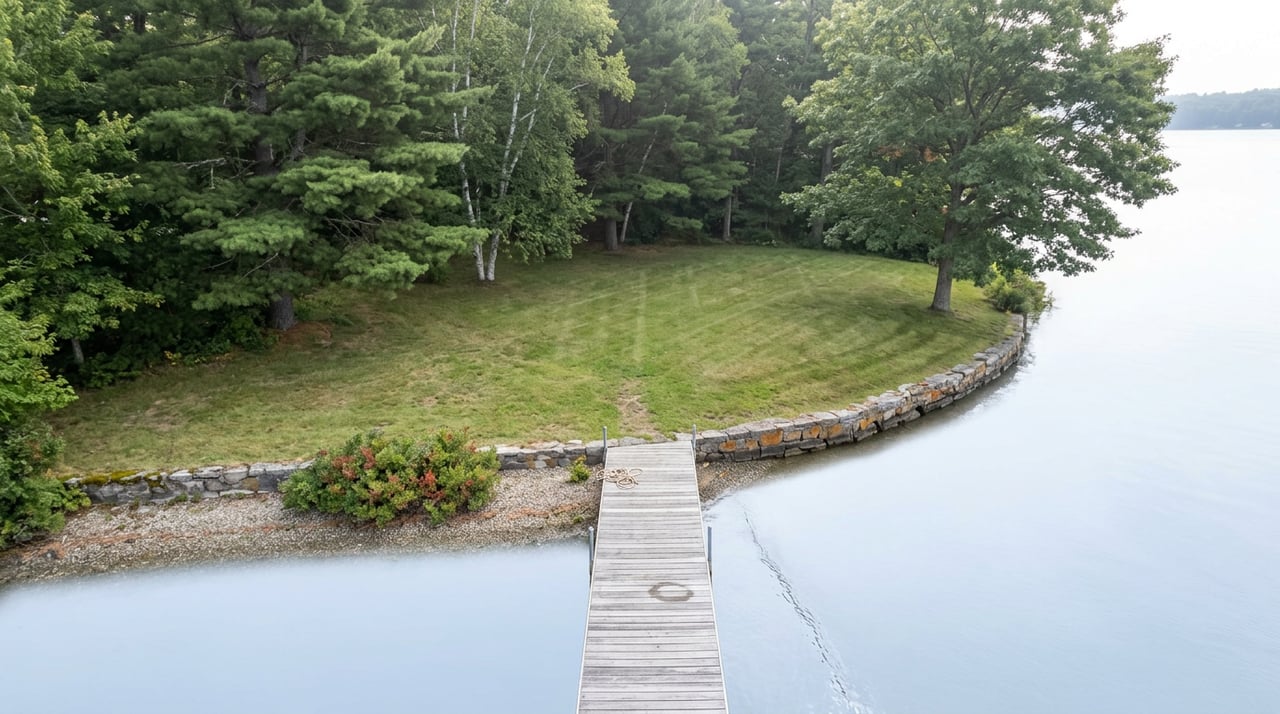
Wolfeboro's Shorefront Lots Sit Longest on the Market. The Dock Paperwork Explains Why.
August 27, 2026
August 27, 2026
Two vacant shorefront parcels in Wolfeboro can carry the same frontage, the same asking price, and the same view of the same cove, and still behave like completely different products once they hit the market. One closes in six weeks. The other sits for the better part of a year. The difference rarely comes down to price or even location. It comes down to whether anyone can prove the dock that used to sit on the lot, or the one a buyer wants to build there, is legally allowed to exist.
As of late May 2026, Wolfeboro's shorefront land carried a median list price of $236,000 across 16 active listings, with a median of 209 days on market. That is the slowest turnover of any Winnipesaukee lakefront town tracked in a recent land market review from the Laconia Daily Sun. Compare that to Meredith, where 10 land listings moved with a median of just 6 days on market, or Gilford, where 14 listings sat a median of 112 days. Alton's 13 listings averaged 63 days. Tuftonboro, the most affordable entry point among these towns at a median $144,450, still moved faster than Wolfeboro at 74 days. Laconia's 18 listings turned over in a median of 18 days.
Wolfeboro is not overpriced relative to its neighbors. Its median list price sits below Gilford's and Alton's. What it has, more than any comparable town on the lake, is a concentration of older shorefront parcels where the paper trail on water access structures has gone missing, gotten separated from the file, or was never created in the first place. Buyers, lenders, and their attorneys have all learned to ask for that paper trail before they will commit. When it is not there, deals stall while someone tries to reconstruct it.
Sellers and listing descriptions use "grandfathered" loosely, as shorthand for "it's been there forever, so it's fine." Under New Hampshire's shoreland and wetlands rules, grandfathered status is not a vibe. It is a specific legal conclusion that depends on when a structure was built relative to two statutory dates, and it has to be demonstrated with evidence.
The first date is September 4, 1978. Seasonal docking structures on New Hampshire waters built before that date are generally treated as legally existing without a wetlands permit, provided the owner can show the structure predates the rule. The second date is November 26, 1996, which governs shoreland structures within 50 feet of the reference line under a separate provision. A dock or boathouse built between those dates, or after 1996 without a permit on file, falls into a much murkier category, and the burden of sorting that out lands on whoever owns the property when the question comes up. That is usually at closing, when a title company, a lender, or a buyer's attorney asks for proof.
Proof means old photographs, site plans, tax record cards showing the structure's presence in a given year, or correspondence with the New Hampshire Department of Environmental Services. If none of that exists, a marine contractor familiar with the process, such as Watermark Marine Construction, will tell you plainly that grandfathered status has to be proven, and that guidance is meant only as a starting point, since every property carries its own facts.
A house with a dock that has been used continuously for forty years, with photos in a family album and a neighbor who remembers it going in, is usually an easier case. A vacant shorefront lot is not. If there is no existing structure, the question shifts from "can we prove this dock is grandfathered" to "can we get a new one permitted at all," and that is a materially different and slower process.
New docking structures, including seasonal docks and boat or jet-ski lifts, require a wetlands permit from the state's Wetlands Bureau. That permit is not automatic. It depends on frontage, site conditions, and how many boat slips the parcel is entitled to under what the industry calls the 75-ft Rule, a provision that allows two boat slips for the first 75 feet of average frontage and one additional slip for each additional 75 feet. A narrow lot that looks perfectly buildable on a plat map may support only a single slip, which changes how a buyer values the parcel for boating use.
Filing for a new permit also costs real money before a shovel goes in the ground. The base application fee for wetlands and shoreline permits rose to $600 as of July 1, 2025, and that figure does not include the marine contractor, surveyor, or engineer typically needed to prepare the application itself. None of this is prohibitive for a buyer who knows it is coming. It becomes a problem when a buyer discovers it mid-transaction, after they have already built a mental picture of summer afternoons at a dock that may take months of state review to secure, if it can be secured at all on that particular lot.
For an owner preparing to list shorefront land, or an older shorefront home with a dock of uncertain vintage, the work worth doing before the first showing is straightforward:
That last step is where a firm like Ames Associates comes in. Their Comprehensive Shorefront Assessment consolidates the existing condition of a property, the permit history of its structures, and what future development the site can support, specifically for owners preparing to bring a shorefront parcel to market. It will not manufacture a permit history that does not exist, but it converts an unknown into a documented answer a buyer can act on, which is precisely what shortens the 209-day wait.
For owners who need actual permitting work done rather than a records search, local contractors such as the Wolfeboro Docking Company manage the application process for new construction, repairs, and modifications, work that state rules increasingly steer toward before, not after, a property changes hands.
If you are the one making an offer on Wolfeboro shorefront, the questions worth asking before you get emotionally attached to a dock or a future dock are simple. Does the seller have documentation showing when the existing structure was built, and does that date fall before September 4, 1978, or before November 26, 1996, depending on which provision applies? If the lot is vacant, has anyone confirmed how many boat slips the frontage supports under the 75-ft Rule? Has a wetlands permit or registration ever been filed for this address, and can that be confirmed through the state's public lookup tool?
None of these questions should scare a serious buyer away from Wolfeboro. They should simply move to the front of the conversation, before the inspection period, rather than surfacing during it.
Does a grandfathered dock automatically transfer to a new owner? The physical structure transfers with the deed, but its legal status does not become clearer just because ownership changes hands. Documentation showing the original construction date still matters to future buyers, lenders, and to the state if questions ever arise about repairs or modifications.
What if the dock is clearly old but there are no photos or records? This is the exact situation that stalls closings. A shorefront assessment or a records search with the town assessor and NHDES OneStop is the practical next step, since verbal recollection alone rarely satisfies a title company or lender.
Do I need a new permit just to replace boards on an existing dock? Straightforward repairs that do not change a structure's size, location, or configuration generally do not require a new permit, though replacing entire crib sections or piles can. When in doubt, a marine contractor familiar with New Hampshire's wetlands rules can tell you quickly whether a project needs sign-off.
Wolfeboro's shorefront land is not a difficult market. It is a market that rewards preparation more than most, because the paperwork behind a dock carries as much weight as the dock itself once a deal is under contract. If you are weighing a Wolfeboro shorefront purchase or getting a family property ready to sell, Lakes Region Homes has spent decades sorting exactly this kind of documentation out before it becomes a closing-day surprise. Let's Connect.
Stay up to date on the latest real estate trends.



Led by Stephen Mardis, Lakes Region Homes is a trusted name in Lake Winnipesaukee waterfront real estate, luxury estates, and second-home properties. Through local expertise, skilled negotiation, and a client-first approach, Stephen delivers exceptional results throughout New Hampshire's Lakes Region.