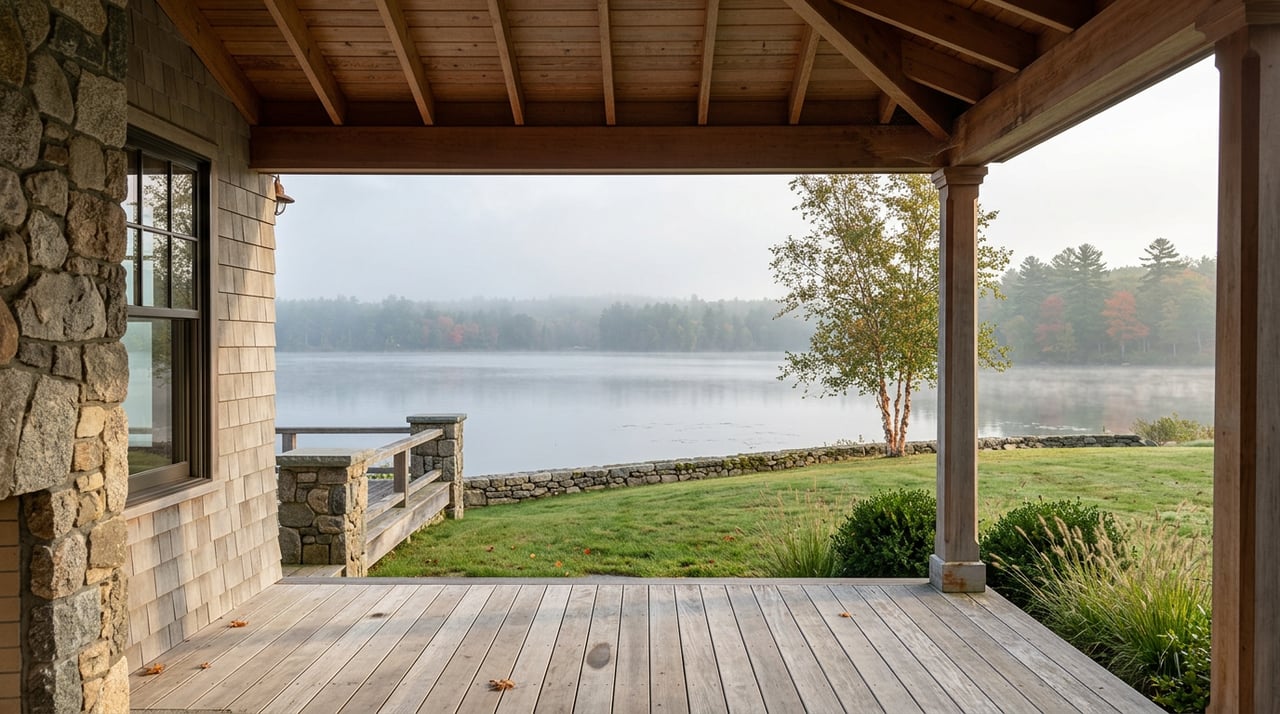
In Center Harbor, the Season Doesn't End on a Calendar. It Ends on a Marine Railway.
September 24, 2026
September 24, 2026
Drive down Main Street in Center Harbor this week and you will hit cones before you hit the Congregational Church. A milling machine has been chewing up pavement from Coe Hill Road toward the church steeple since September 15, and the same crew is repaving the Main Street junction with Route 25B and rebuilding the Wood Ridge Road intersection out toward Waukewan Road. It is loud, it is inconvenient, and if you have lived here more than a season, you already know it is not really about the road.
Nine days before the first mill hit asphalt, this same short stretch of downtown hosted a lantern festival. Two days after that, residents voted in town and school board elections. The day after the votes were counted, the Board of Selectmen stood up and read a proclamation marking the 250th anniversary of Congress naming the country the United States of America. Four distinct events, one block, nine days. That is not a coincidence of scheduling. It is what happens when a town this small does its civic and commercial business on a Main Street short enough that a single paving contract touches nearly everything in it at once.
The pattern underneath all of it is worth naming plainly, because it explains something about how this town actually works that a summer visitor would never notice: Center Harbor runs two separate calendars on the same three or four blocks, and the businesses that survive the switch from one to the other are not the ones that had the best summer. They are the ones that were never built around the summer in the first place.
The town's own notice is specific about the route: Main Street from Route 25/Coe Hill Road to the Congregational Church gets milled and repaved, the Main Street and Route 25B junction gets cut at the road joint and repaved, and Wood Ridge Road gets reconstructed at its intersection with Waukewan Road along with shoulder repairs further up. That corridor is not a random collector road. It is the same several blocks where Taphouse Winnipesaukee opened in the Coe House at 18 Main Street, and it runs past the same town docks where the lantern festival set up nine days earlier.
The timing is not an accident either. Late September sits in the narrow shoulder window after Labor Day traffic thins out and before hard frost makes asphalt work impractical. A town with one real commercial street schedules its capital work here because there is no other week that does less damage to the businesses that depend on foot traffic.
Taphouse Winnipesaukee moved into the Coe House, an 1800s Victorian mansion on the National Register of Historic Places, with a soft opening in spring 2025. The numbers tell you what kind of business it is built to be: a 150-seat restaurant paired with a 100-seat biergarten looking out over the lake, three full bars, and live entertainment scheduled Thursday through Sunday from May through October. That is not an incidental detail. It is the operating plan. The biergarten, the entertainment lineup, and much of what makes the Taphouse a destination are tied to a five-month window that closes at the same time the Mount Washington's cruise season does.
Walk past in November and you will still find the restaurant open, since the venue itself does not close for winter. What disappears is the version of the block built around a warm patio and a live band on a Friday night. That version runs on the same calendar as the boat traffic in the harbor below it, and when that traffic stops, so does the reason a hundred-seat outdoor bar makes sense.
Half a mile away on Whittier Highway, Canoe Restaurant & Tavern has been serving the same stretch of shoreline for more than 23 years under chef and owner Scott Ouellette. Its listed hours run seven days a week except Wednesday, no seasonal asterisk attached, the same schedule in January that it runs in July. The restaurant spreads across five distinct dining areas, including a private room called the Oar House, but none of that variety is pitched as a summer feature. It is simply how the place has operated since before most of the newer businesses on Main Street existed.
The Mug tells a similar story from the opposite end of town, out on Daniel Webster Highway. It draws golfers finishing a round at the nearby course and locals who treat it, as one longtime patron put it, as their unofficial nineteenth hole. Homemade soups, seafood chowder, a busy dining room of regulars. Nobody schedules a trip to Center Harbor around the Mug's calendar because the Mug does not have one. It is simply open.
Here is the contrast in one place:
| Business | Location | What changes after October |
|---|---|---|
| Taphouse Winnipesaukee | 18 Main Street, the Coe House | Live entertainment and biergarten programming stop; restaurant hours continue |
| Canoe Restaurant & Tavern | 232 Whittier Highway | Nothing; same seven-day schedule minus Wednesday, year-round |
| The Mug | Daniel Webster Highway (Route 3) | Nothing; golf-season regulars are replaced by everyone else |
| Mount Washington | Lake Street shipyard | Comes out of the water entirely for winter |
The detail most residents have seen without ever thinking through is the one that best proves the point. Center Harbor is the Mount Washington's winter home port. The flagship runs its cruise season from late May through late October, stopping at five ports around the lake including Wolfeboro, Meredith, Alton Bay and Weirs Beach. When that season ends, the 230-foot vessel does not just tie up quietly at the dock. It gets hauled entirely out of Lake Winnipesaukee on a marine railway at the Center Harbor shipyard on Lake Street, the same yard that sits a short walk from the New Hampshire Boat Museum. Bubblers keep the surrounding water from freezing around the hull while it sits in dry dock for the winter, a maintenance step the company only undertakes when major work requires it.
That image, a full-sized excursion steamer sitting on rails a few hundred yards from Main Street's coffee shops and taverns, is the clearest evidence in town that the tourist season and the town's actual working calendar are two different things running on the same real estate. The lantern festival crowd that filled the town docks on September 6 was standing a stone's throw from where the ship they may have photographed would be pulled out of the water within weeks.
None of this is a warning or a complaint. It is simply how a town with one short commercial street absorbs a five-month tourist economy without losing its year-round character. The businesses that depend on the summer calendar, like the Taphouse's biergarten programming, wind down cleanly and predictably every fall. The businesses that never depended on it, like Canoe and the Mug, do not notice the switch at all. And the town itself uses the same narrow gap between seasons to do the infrastructure work that would be impossible to schedule any other week.
If you want to see the actual proof that the season has turned, skip the calendar and walk down to the Lake Street shipyard some week in late October or early November. When the Mount Washington comes out of the water, that is Center Harbor's real seasonal marker, not the last warm Saturday or the first frost.
Understanding a town's rhythm this closely, which streets carry the summer crowds and which stay quietly busy all winter, which docks matter in July and which matter in December, is the same kind of groundwork that goes into evaluating a piece of waterfront property here. If you are thinking about a home on this stretch of Lake Winnipesaukee and want someone who reads these seasonal patterns the way you would read a survey, Lakes Region Homes is a good place to start that conversation. Let's Connect.
Stay up to date on the latest real estate trends.

Led by Stephen Mardis, Lakes Region Homes is a trusted name in Lake Winnipesaukee waterfront real estate, luxury estates, and second-home properties. Through local expertise, skilled negotiation, and a client-first approach, Stephen delivers exceptional results throughout New Hampshire's Lakes Region.