Tuftonboro's Median Price Is Telling You Half the Story
August 13, 2026
August 13, 2026
As of July 2026, the median home price in Tuftonboro sits at $799,000. The average sale price for the same stretch of listings comes in at $1,251,031. That is not a typo and it is not noise. A gap that size, in a town this small, means two different products are being counted under one number.
Most buyers scanning Tuftonboro treat the median as a single data point they can compare against Wolfeboro or Moultonborough down the road. It is not one market. It is at least two, and the line between them runs through the water.
In a large market, median and average track close together because enough transactions smooth out the outliers. Tuftonboro does not have that luxury. Listings in town have ranged from $150,000 to $12,899,000, and homes are taking an average of 86 days to sell as of July 2026. With a housing stock that small, a handful of high-end island and waterfront closings can pull the average well above the median without moving the median itself very much.
Earlier in the year, Movoto listed the median asking price at $995,000 in April 2026, a figure that had swung 23 percent from the month before. That kind of month-to-month volatility is not a sign of an unstable town. It is a sign of a thin market where each closing carries outsized weight, which is exactly what you would expect when a meaningful share of inventory sits on islands that rarely change hands.
The number worth sitting with is this: whatever the median tells you about Tuftonboro, it is being pulled upward by a category of property the median itself does not describe.
Tuftonboro holds 27 of Lake Winnipesaukee's 274 islands, more than almost any other town on the lake. That fact alone should reshape how a buyer reads the town's price data, because those 27 islands do not share one access model. They split into two distinct categories, and the category determines almost everything else about ownership.
| Access type | Islands | What it means for a buyer |
|---|---|---|
| Bridged to the mainland | Black Cat, Governors, Long, Oak, Worcester | Drive to the property. Standard financing and insurance underwriting in most cases. |
| Boat or mail-boat access only | Bear, Birch, Cow, East Bear, Jolly, Loon, Three Mile, Sandy | No car access. Mail, groceries, and guests arrive by water. Financing and insurance require extra steps. |
The eight islands in the second column are served by the U.S. Mail's Winnipesaukee boat, one of the oldest working mail boats in the country. That detail is charming until you are the one trying to schedule a home inspector, a propane delivery, or a mortgage appraiser around a boat schedule instead of a driveway.
The friction does not show up in the listing. It shows up during underwriting, and it shows up late.
Insurance is the first wall most buyers hit. Most New Hampshire carriers licensed in the state will not quote an island home at all, regardless of the coverage amount a buyer is willing to pay. The reasoning is practical rather than arbitrary. A broken window in November on a seasonal, boat-access property can sit undiscovered until spring, by which point a $250 repair has become a multi-thousand-dollar water damage claim. Insurers price for that gap in visibility, and many simply decline to write the policy rather than price around it.
Utilities follow the same logic on a different axis. Diamond Island, a 47-acre island just off mainland Gilford on the same lake, has no electrical service at all. Owners there run on generators or solar, a detail worth knowing even though Diamond Island sits in Gilford rather than Tuftonboro, because it shows what "boat access only" can mean in practice on this lake. Tuftonboro's own eight mail-boat islands carry the same structural reality: no bridge means no guaranteed grid connection, and every mechanical system on the property, from the well pump to the heat, has to be planned around that constraint rather than assumed.
None of this means an island purchase is a bad decision. It means the due diligence period looks different, and a buyer who assumes a standard 30-day close and a standard homeowners policy will lose time discovering otherwise.
The second layer of friction sits in the paperwork, and it applies just as much to shared mainland waterfront as it does to islands.
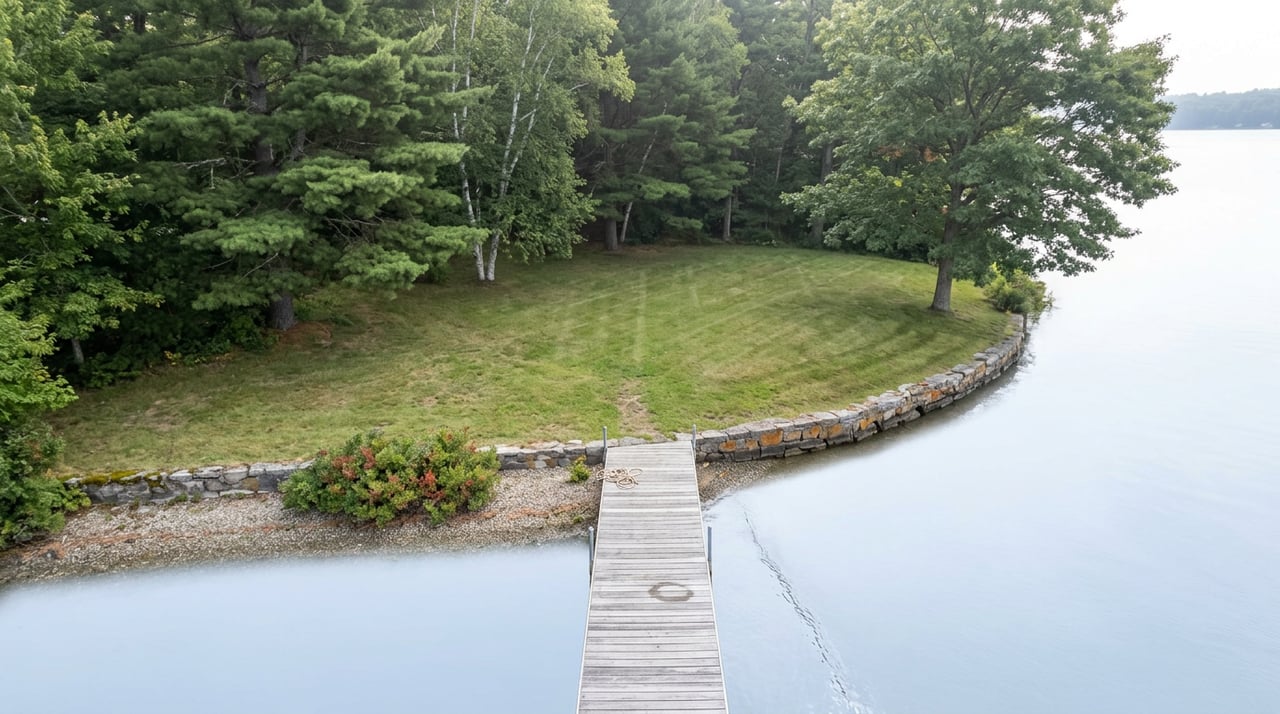
A lot of Tuftonboro waterfront, especially in associations and smaller subdivisions, comes with deeded dock access rather than a private dock. The deed language often reads something like "to be used in common with" a neighboring parcel. That phrase sounds like a guarantee. It is closer to a starting point for a conversation.
"Use in common with" typically establishes shared access, but it rarely spells out who pays for repairs, how usage is scheduled during peak weekends, or what happens if a co-owner installs their own boat lift without asking. Those gaps get resolved by written agreement, not by the deed alone, and a buyer who assumes the deed settles everything is the same buyer who ends up in a dispute two summers later.
State rules add another layer worth knowing before you fall for a listing photo. Lake Winnipesaukee is the only lake in New Hampshire larger than 10,000 acres, which means it runs on a different, larger boat slip standard than every other lake in the state. A dock's permitted size is tied directly to how much shoreline frontage the property owns, and any new docking structure, including a boat lift or jet ski lift, requires a state wetlands permit regardless of how small the project seems. A property with 75 feet of qualifying frontage can generally support a modest seasonal dock. A property with less, or one that shares frontage across several deeded owners, may not qualify for a private dock at all, no matter what the seller's photos suggest.
A buyer weighing a Tuftonboro listing against something in a neighboring town should get answers to these before assuming the two are comparable:
None of these questions show up in a portal search filter. All of them show up in a purchase and sale negotiation.
The lesson from Tuftonboro's numbers is not that the town is expensive or affordable. It is that the median and the average are each telling the truth about a different slice of the same eight square miles of water. A buyer who only reads the headline number risks either overpaying for a mainland property they expected to be comparable to the town average, or underestimating what an island purchase actually requires once insurance, access, and dock rights enter the picture.
The fix is not a better number. It is asking which category a specific listing falls into before comparing it to anything else.
Is it harder to get a mortgage on a Tuftonboro island home than a mainland one? It can be. Lenders generally want confirmed, renewable insurance in place before closing, and since many carriers decline island properties outright, buyers sometimes need more lead time to find a company willing to write the policy before financing can move forward.
Do all of Tuftonboro's islands lack road access? No. Five of Tuftonboro's islands, Black Cat, Governors, Long, Oak, and Worcester, are bridged to the mainland and reachable by car. The remaining islands in town require boat access, with mail and deliveries handled by the lake's mail boat service.
Does a "deeded dock" guarantee I can use it the way I want? Not automatically. Deeded access establishes a right to use a dock, but the specific terms, including maintenance costs and scheduling, depend on the exact language in the easement and any separate written agreement between the parties involved.
If you are comparing Tuftonboro against other Winnipesaukee towns and want to know which category a specific listing actually falls into before you make an offer, Lakes Region Homes can walk through the access, insurance, and dock questions with you before they become closing-week surprises. Let's Connect.
Stay up to date on the latest real estate trends.



Led by Stephen Mardis, Lakes Region Homes is a trusted name in Lake Winnipesaukee waterfront real estate, luxury estates, and second-home properties. Through local expertise, skilled negotiation, and a client-first approach, Stephen delivers exceptional results throughout New Hampshire's Lakes Region.